
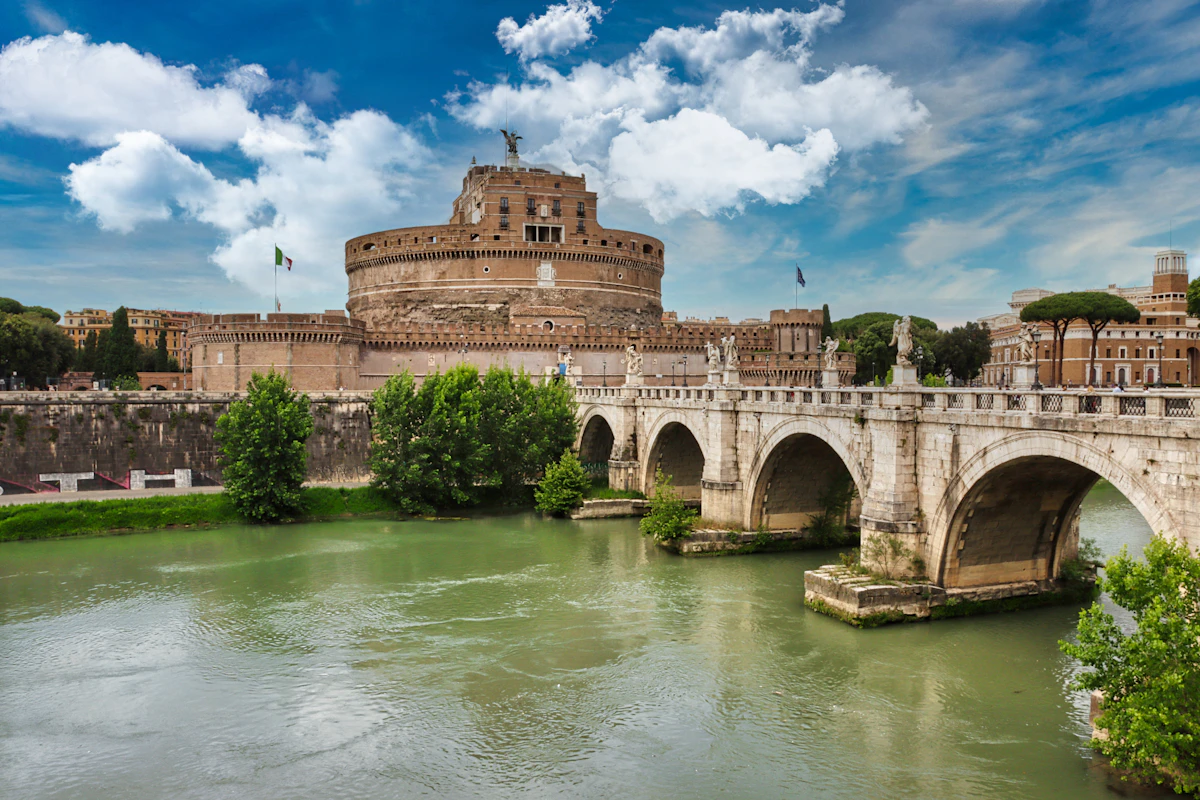
Castel Sant'Angelo Guide: Tickets, Prices & Booking
1 - 1.5 h
Fortress & Museum
Built 135-139 AD as Hadrian's mausoleum
Lungotevere Castello, 50, 00193 Roma, Italy
Planning to visit Castel Sant'Angelo?
Compare ticket and city-pass options for this attraction.
Practical Visitor Info & Tips
€18.00
€2.00
Tuesday - Sunday: 09:00 - 19:30 · First Monday of the month: 14:00 - 20:00 (hours vary — see full schedule below)
Reserved timed-entry ticket via the official booking platform.
| Year-round | Tuesday - Sunday | 09:00 - 19:30 | Last Admission: 18:30 |
| 3 Aug - 7 Dec 2026 only | First Monday of the month | 14:00 - 20:00 | Last Admission: 19:00 |
Closed On: Mondays (except the special first-Monday openings listed above), 1 January, 25 December
Entry to Castel Sant'Angelo (Museo Nazionale) and current exhibitions, plus one free same-visit-or-within-2-days entry each to Casa Museo Boncompagni Ludovisi and Casa Museo Hans Christian Andersen (promotional, through 31 Dec 2026). Radioguides are excluded and cost extra.
| Option | Price | Reservation | Booking |
|---|---|---|---|
| Adult (year-round, Tue-Sun) | €18.00 | Timed entry | CoopCulture |
| Reduced (EU 18-25) | €2.00 | Timed entry | CoopCulture |
| "I Lunedì di Castello" special (first Monday/month, 3 Aug-7 Dec 2026, 14:00-20:00) | €5.00 (€2.00 reduced) | Timed entry | CoopCulture |
Overview & Visitor Introduction
Castel Sant'Angelo is a fortress on the bank of the Tiber, originally built as Emperor Hadrian's mausoleum and later used as a papal fortress, prison, and residence — a role it held during several historical papal emergencies, connected to the Vatican by the elevated Passetto di Borgo corridor.
Standard admission is EUR 18.00 (EUR 2.00 reduced for EU citizens 18-25), effective from a 1 July 2026 price update. Tickets are nominative and timed, booked via the official CoopCulture platform, with a matching photo ID required at entry.
The visit follows the building's layered structure in one continuous route: Hadrian's original 2nd-century spiral ramp climbs through the core of the mausoleum, opening into courtyards, storerooms, and former prison cells added when the popes converted it into a fortress, then into the frescoed Renaissance papal apartments (including the Sala Paolina) that served as a papal residence, and finally onto the open-air terrace at the top, beneath the bronze angel statue.
That terrace is one of central Rome's higher accessible viewpoints — it looks west over the Tiber and Ponte Sant'Angelo toward the dome of St Peter's Basilica, and east across the rooftops of the historic center. It is also the real setting for the final act of Puccini's opera Tosca, where the title character's story ends on these battlements.
The building's layout works against easy access: floors connect via the original spiral ramp and then staircases through the upper levels, with significant elevation change overall. CoopCulture, the official ticketing operator, describes wheelchair access as limited to partial use of the external spaces rather than the full circuit, and offers accessible guided tours as an alternative for visitors who cannot or prefer not to use stairs — confirm current conditions directly with CoopCulture if mobility is a concern. Separately, the adjacent Ponte Sant'Angelo — the Bernini-angel-lined bridge leading to the entrance — is a public pedestrian bridge open at all times at no cost and is not part of the paid museum. Given its short walking distance from the Vatican Museums and St Peter's Basilica, Castel Sant'Angelo is often visited on the same day as the Vatican area.
History & Significance
Built between 135 and 139 AD as a mausoleum for Emperor Hadrian and his family, the structure was converted into a military fortress in the 5th century and later became a papal stronghold, connected to the Vatican by the Passetto di Borgo — a fortified corridor popes used to flee to safety during sieges, most famously in 1527.
The building's name comes from a 590 AD legend in which Pope Gregory I saw a vision of the Archangel Michael sheathing his sword atop the mausoleum, signaling the end of a plague — commemorated today by the bronze angel statue crowning the fortress.
What to See: Top Highlights
The Terrace & Bronze Angel
Panoramic views over the Tiber, St Peter's Basilica, and central Rome.
Papal Apartments
Renaissance-era rooms once used as a papal residence, with frescoes and period furnishings.
Ponte Sant'Angelo
The Bernini-designed angel-lined bridge connecting the fortress to the city center.
Which is the Best City Pass for Rome?
We analyze prices, ticket options, and transport deals for Rome.
Location & Google Maps
Pass Compatibility
Compare Rome PassesIncluded as one of Roma Pass's and Omnia Card's free-choice admissions (via the bundled Roma Pass component) — confirmed as part of the 45+ site network alongside the Colosseum and Galleria Borghese. Turbopass Rome City Pass includes it directly, with the reservation processed at checkout.
Roma Pass
Conditional. Free if this visit counts within your pass's included free-admissions quota. A discount applies once your pass's free-admission quota has been used; the exact current amount should be confirmed when booking. One of the pass's free-choice admissions — the 72h Roma Pass grants 2 free-choice admissions total (1 for the 48h pass), visitor's choice, any order, from a network of 100+ sites. Confirmed directly on the pass's own official page. Not automatically free beyond your quota: further participating-site visits get a reduced rate that varies by venue, not a single flat percentage.
Turbopass Rome City Pass
Included. The pass provider pre-books your entry ticket at checkout. Explicitly listed on the official Turbopass Rome City Pass product page.
Omnia Card 72h
Conditional. Free if this visit counts within your pass's included free-admissions quota. A discount applies once your pass's free-admission quota has been used; the exact current amount should be confirmed when booking. Included via Omnia's bundled Roma Pass component, using the same free-choice-quota mechanic (2 admissions for the 72h Roma Pass this card includes). Not automatically free beyond that quota — further visits get a venue-specific reduced rate.
Data Provenance
Frequently Asked Questions
How much does Castel Sant'Angelo cost?
Do I need to book in advance?
Is Castel Sant'Angelo included in Roma Pass?
Is Castel Sant'Angelo included in Turbopass or Omnia Card?
How does it connect to the Vatican?
How long should I plan for a visit?
What will I actually see inside?
Is Castel Sant'Angelo accessible for wheelchair users?
Can I visit with young children?
Is the bridge (Ponte Sant'Angelo) part of the paid ticket?
What's the biggest mistake people make when visiting?
What's the best time to visit to avoid crowds?
Is a City Pass Worth It in Rome?
Compare pass options, prices, ticket entry rules, and transportation.
View Rome Pass Comparison